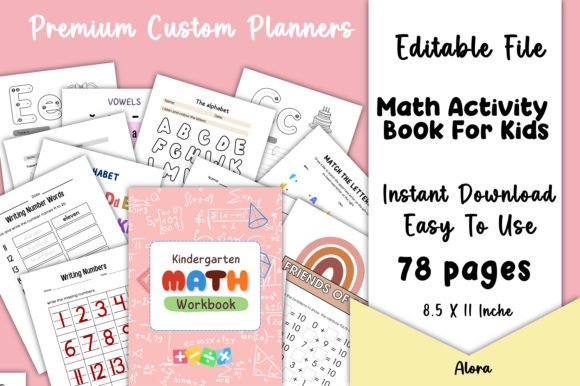
Math Activity Book for Kids Canva KDP
If you're building a sustainable KDP publishing business—or expanding your creative product line—Math Activity Book for Kids Canva KDP isn’t just another template. It’s a strategic asset: a tested, editable interior framework that bridges design flexibility with market-ready structure. Unlike static PDFs or untested layouts, this resource gives you full control over text, colors, fonts, and layout—without requiring graphic design expertise or expensive software subscriptions. You’re not buying a finished book. You’re acquiring decision leverage: the ability to iterate quickly, align visuals with your brand voice, and respond to real-time feedback from parents, teachers, or reviewers.
Why Editable Canva Interiors Change How You Plan and Launch
Most new KDP creators underestimate how much time gets lost in revision cycles—especially when outsourcing design or wrestling with desktop publishing tools. With Math Activity Book for Kids Canva KDP, every change happens in minutes, not days. Need to adjust font size for readability? Swap a color scheme to match your series branding? Replace placeholder instructions with grade-aligned learning objectives? All possible in one interface—no re-exporting, no version confusion, no dependency on third-party designers.
This agility directly supports long-term positioning. For example, if you’re launching a bundle of kindergarten workbooks (e.g., “Kindergarten Math Activity Book For Kids KDP Interiors Canva Templates”), consistency across interiors becomes a subtle but powerful trust signal. Parents recognize visual coherence; educators scan for clarity and age-appropriate spacing; Amazon’s algorithm rewards high-quality, well-structured interiors through improved conversion rates and lower return requests.
When to Use It—and When to Pause and Think First
Use Math Activity Book for Kids Canva KDP when you need speed without sacrificing control: launching seasonal bundles, A/B testing cover + interior combinations, or responding to niche demand (e.g., “counting to 20” vs. “early addition only”). But avoid deploying it reflexively. Before editing, ask three questions:
- What outcome am I optimizing for? Is it faster time-to-market? Higher perceived value? Better alignment with a specific curriculum standard (like Common Core or state-specific early math benchmarks)?
- Who is the primary user—not buyer—but actual user? A 5-year-old doesn’t read instructions. Their adult facilitator does. So clarity for caregivers matters more than decorative flourishes. Edit with that hierarchy in mind.
- Does this version support my broader product ecosystem? If you offer printable versions, digital downloads, or classroom packs, ensure interior spacing, font legibility, and activity density remain compatible across formats.
Skipping these checks turns an efficient tool into a liability. A beautifully redesigned page that’s too dense for young eyes may increase bounce rates on your sales page. Over-customizing fonts or colors without testing print fidelity can trigger KDP warnings—or worse, inconsistent physical copies.
Strategic Editing: Beyond Aesthetics
Editing isn’t just about making things “look nice.” With Math Activity Book for Kids Canva KDP, thoughtful edits shape learning outcomes. Consider these practical levers:
- Spacing and white space: Reduce cognitive load. Kindergarteners benefit from generous margins, clear separation between problems, and minimal visual clutter. Adjust grid layouts—not just colors—to support focus.
- Instruction language: Replace generic prompts like “Solve” with action-oriented, developmentally appropriate phrasing: “Circle the group with more apples,” “Draw lines to match numbers to pictures,” or “Color the shape that has four corners.” These small shifts improve usability and reduce caregiver explanation time.
- Progressive scaffolding: Rearrange pages—not just reorder, but rebuild flow. Start with concrete, visual tasks (counting objects), move to semi-abstract (number lines), then introduce symbolic notation (equations). Your edits should reflect pedagogical intention, not just aesthetic preference.
You don’t need a teaching degree to make these decisions—but you do need awareness of early math progression. That’s where research-informed templates add quiet, compounding value. The included 78-page structure isn’t arbitrary. It’s calibrated around attention spans, skill-building sequences, and KDP’s 8.5″ x 11″ trim size—ensuring content fits without awkward scaling or cropping.
Risks of Using Without Context
The biggest risk isn’t technical—it’s strategic drift. Because Math Activity Book for Kids Canva KDP is so easy to edit, it tempts users toward endless tweaking: changing fonts mid-project, adding decorative elements that compromise readability, or inserting activities outside developmental scope—all in pursuit of “uniqueness” rather than utility.
That dilutes differentiation. What makes your workbook stand out isn’t whether the number 3 is outlined in gold foil—it’s whether a child can independently complete page 12 after finishing page 5. Consistency of difficulty, clarity of visual cues, and reliability of answer placement matter more than novelty. Random customization erodes those anchors.
Another under-discussed risk: brand fragmentation. If each workbook uses wildly different typography, icon styles, or layout logic, buyers won’t recognize your series as cohesive—even if titles share keywords. That weakens cross-selling, reduces repeat purchases, and blurs your authority in the “kindergarten math” space.
How to Build Long-Term Value, Not Just One-Off Listings
Treat Math Activity Book for Kids Canva KDP as infrastructure—not inventory. Your first edit shouldn’t be “what color should the title be?” It should be “how will I version-control this across future releases?”
Start simple: duplicate the Canva file and rename it with a clear system (e.g., “Kindergarten_Math_Counting_v2_BrandA”). Then, create a lightweight style guide—even just a text doc—listing your approved fonts, primary/secondary colors, heading hierarchy, and margin rules. This ensures scalability. When you launch your third or fifth math workbook, consistency emerges organically—not through memory or guesswork.
Also consider interoperability. Does your Canva file export cleanly to other tools if needed? Can you extract SVG icons for use in marketing assets? Does the PDF meet KDP’s bleed and resolution requirements *before* final export? Testing these early prevents last-minute scrambles and preserves your launch timeline.
Realistic Use Cases That Deliver Results
Here’s how experienced creators apply Math Activity Book for Kids Canva KDP intentionally:
- Educator Partnerships: Customize interiors with school-district-approved fonts or bilingual labels (e.g., English/Spanish instructions) before pitching to PTA groups or homeschool co-ops.
- Seasonal Bundles: Create themed variants (Back-to-School, Winter Counting, Spring Addition) by editing headers, clipart, and color palettes—keeping all structural logic intact.
- A/B Testing on Amazon: Publish two versions—one with minimalist interiors, another with illustrated borders—then compare ACOS, session duration on your sales page, and customer review sentiment about “ease of use.”
- Content Repurposing: Extract individual activity pages as lead magnets (e.g., “Free Kindergarten Number Tracing Page”) while keeping your master Canva file intact for future updates.
None of these require advanced skills—just clarity of purpose and disciplined execution.
Final Thought: Tools Don’t Build Businesses—Decisions Do
Math Activity Book for Kids Canva KDP succeeds not because it’s editable, but because it enables better decisions—about audience needs, production timelines, brand integrity, and educational impact. It gives you room to experiment, yes—but only when grounded in observation, not assumption. The intro page isn’t filler. It’s your first chance to signal credibility. The KDP-tested dimensions aren’t constraints—they’re guardrails against costly formatting errors. And the Canva Editable File isn’t convenience—it’s continuity. Every time you open it, you’re choosing intention over inertia.
So before you change that font or shift a column: pause. Ask what this edit serves—not just today’s listing, but next quarter’s catalog, next year’s brand reputation, and the quiet confidence that comes from shipping work that works.