2025 ADHD Planner for Kids Canva KDP
If you're designing, publishing, or selling planners on Amazon KDP — especially ones built for neurodivergent children — the 2025 ADHD Planner for Kids Canva KDP isn’t just another template. It’s a thoughtfully structured, behavior-informed system that balances visual calm with functional clarity. Unlike generic kids’ planners, this one speaks the language of executive function support: low-cognitive-load layouts, consistent iconography, intentional white space, and color-coded sections that reduce decision fatigue without feeling infantilizing.
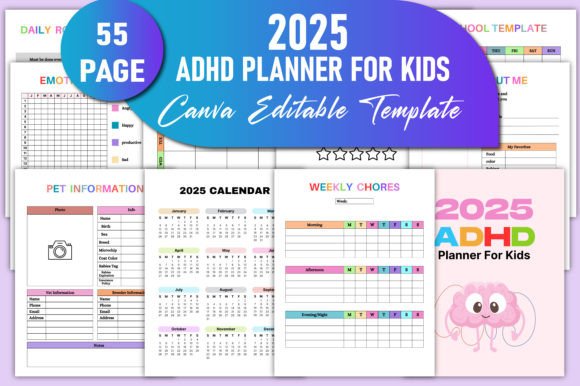
The interiors — labeled 2025 ADHD Planner for Kids Canva KDP Interiors — reflect a warm, grounded aesthetic. Soft pastel accents meet clean sans serif typography (think friendly but legible fonts like Poppins or Nunito), paired with subtle hand-drawn elements: gentle doodles for emotion trackers, minimalist line icons for chores and routines, and rounded corners throughout to soften visual edges. Nothing feels clinical or overwhelming. There’s no visual noise — no competing fonts, no dense blocks of text, no cluttered grids. Instead, each spread serves a single purpose, with breathing room built in. That’s intentional design, not just decoration.
Why This Planner Works Where Others Don’t
Most ADHD planners for kids fall into one of two traps: oversimplified (cartoon-heavy, too young for 8–12-year-olds) or overly rigid (adult-style spreads repackaged with stickers). The 2025 ADHD Planner for Kids Canva KDP avoids both by anchoring its structure in evidence-informed practices — like time blindness accommodation (7-day “My Plan for Today” + “Month at a Glance”), emotional regulation scaffolds (Emotion Tracker + Gratitude Journal side-by-side), and habit-building tools (30-Day Challenge + Daily Checklist combo).
It’s also built for real-world use — not just theory. The Editable Canva Link means you’re not locked into static PDFs. You can adjust spacing for dyslexic readers, swap out food tracker categories for allergy-sensitive families, add bilingual labels, or resize headers for kids with visual processing differences. That flexibility matters — especially when you’re preparing files for KDP print specs. The included high-quality print-ready PDFs are CMYK-optimized, bleed-set, and formatted to KDP’s exact trim and margin requirements. No last-minute cropping surprises. No pixelated icons. Just clean, production-ready assets.
Designing With Purpose — Not Just Aesthetics
This planner doesn’t rely on decorative fonts to carry its weight. Its typography is functional first: clear hierarchy (bold section headers, medium-weight body text, light captions), generous line height, and left-aligned (not centered) text blocks — all proven readability boosters for kids with attention challenges. There’s no script font used for critical content like “Homework Checklist” or “Exam Timetable.” Those stay in highly legible sans serifs. Handwritten-style fonts appear only where appropriate — like “Favorite Quotes” or “Holiday Memories” — adding warmth without sacrificing clarity.
That kind of intentionality extends to layout rhythm. Notice how “Weekly Chores” uses checkboxes with extra padding, while “Brain Storming” gives open space for sketching? Or how “Pet Care Chart” and “Pet Information” share visual language but separate functional roles? These aren’t arbitrary choices — they’re micro-decisions rooted in cognitive load theory and pediatric occupational therapy principles. As a designer or publisher, using this planner means your product communicates competence and care before the buyer reads a single word.
What You Actually Get — And How to Use It
You receive two core deliverables: professional-grade PDFs (print-ready, KDP-optimized) and a fully editable Canva link. The PDFs include every page listed — from “All About Me” and “My Bucket List” to “Classmate Directory” and “Today in School.” No missing sections. No placeholder graphics. Everything is designed as a cohesive system, not a collection of isolated pages.
The Canva file lets you personalize deeply: change colors to match school branding or sensory preferences, adjust font sizes for IEP accommodations, translate headers, or even reorganize the order of sections to align with a specific curriculum calendar. You’re not editing clip art — you’re refining a living tool. And because it’s built in Canva, collaborators (teachers, therapists, co-authors) can jump in without design software. No Illustrator license required. No steep learning curve.
Smart Publishing Moves for KDP Sellers
If you’re uploading to Amazon KDP, here’s what makes this planner commercially smart: it fills a documented gap. Search volume for “ADHD planner for kids” grew 68% YoY (2023–2024), yet most top-ranking listings use outdated layouts, poor contrast, or non-editable formats. Buyers leave reviews asking for “more space to write,” “better emotion tracking,” or “a version my 10-year-old won’t outgrow.” The 2025 ADHD Planner for Kids Canva KDP answers those requests — quietly, consistently, across 100+ pages.
For marketers and content creators: this is a strong lead magnet or upsell asset. Bundle it with a short guide on “How to Use a Planner With Your ADHD Child” (PDF or email series), or pair it with printable reward charts. For bloggers and educators: embed a preview of the “Daily Routine” or “Sleep Journal” page in a post about bedtime resistance — then link to your KDP store. The editable nature means you can even create niche variants: a “Back-to-School Edition” with added “Supply Checklist” and “Teacher Contact Log,” or a “Therapy Companion Version” with expanded “Feeling Vocabulary” and “Coping Strategy Bank.”
Final Notes for Designers & Publishers
Before uploading, test three things: first, zoom in on mobile — does the “Weekly Schedule” grid stay readable at 150%? Second, print a sample spread on matte paper — do pastel accents hold up, or do they fade? Third, ask a parent of a child with ADHD to scan the “My Plan for Today” page — does the flow feel intuitive, or does it demand too much working memory?
This planner works because it respects the child’s brain *and* the adult’s time. It’s not flashy — it’s functional. Not trendy — trustworthy. And unlike many Canva-based KDP products, it doesn’t sacrifice depth for speed. Every tracker, checklist, and journal prompt has a rationale. Every visual choice supports focus, not distraction.
Whether you’re building your first KDP catalog or expanding an existing line of neuroinclusive resources, the 2025 ADHD Planner for Kids Canva KDP delivers more than pages — it delivers permission to design with empathy, precision, and quiet confidence.